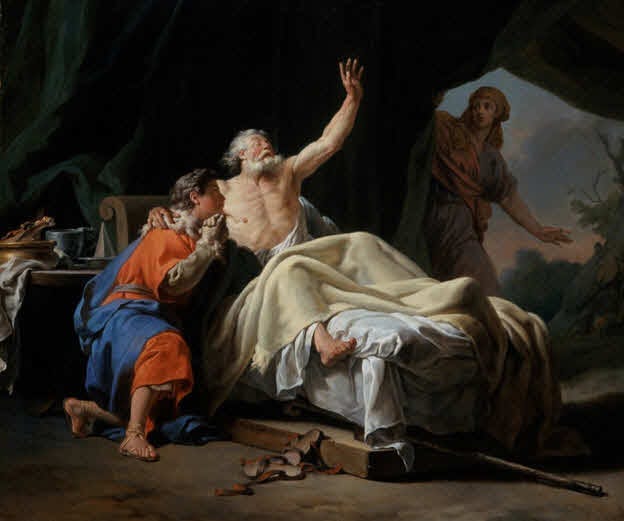
Esau's blessing

I am of this world, but not in it as Jacob my brother.
I tell my father what he wants to hear.
My mother knows me better and sheds a tear.
My brother is a fool in his worship
of the Lord Who hides in the heavens.
Yet I am the hunter who brings meat
to the table of my father and his gilded seat.
I remember him guiding me to righteousness
in his way, but I am righteous in my way.
I do not fear the Lord, He has bothered me little.
But the blessing of my father I do not belittle
as I desire his love.
Is not love of father and mother
what the Lord wants anyway I tell him?
Yet when I went to my father for his blessing
snitty Jacob had taken it from me.
Is there no blessing, not one left for me, my father?
I wept, bereft at the theft of my brother.
I had prepared for the blessing of my father
with the skill of a hunter seeking the best
of the field’s venison at my father’s behest
as he had tasked me, his favored one, to prepare solely.
His gift of words was for me only!
I may not care but the power of the Lord
glows in my father’s eyes – his right hand grips
the Lord’s as my right hand grips his.
To my father’s table with silver spoons laid
my shifty brother brought meat his mother made.
Jacob may fear the God in heaven
but I am no fool, as he.
My mother’s tricks may have hurt me
yet I will speak kindly to my father without woe
till he leaves this world- with Jacob, by my hand, in tow.
What was Esau thinking?

Basically Esau is not into the religious stuff-I think that is pretty clear from the chapter we read in Genesis that tells the story. Yet he loves his father and would do anything for him.  He also wants his father’s deathbed blessing even though his connection to the Almighty is not  nearly as powerful as both of Esau’s parents, Isaac and Rebecca, would most certainly have preferred.  In fact, Rebecca was aghast that her son Esau would get the blessing that she felt Jacob, her more God fearing son, certainly deserved.  She therefore insisted her son Jacob pretend to be Esau in order to get the blessing instead.  The consequences of that misdirection were enormous and in sad hindsight totally unnecessary because Isaac knew his sons well and had reserved a different and appropriate blessing for Jacob.  The one that Jacob stole was truly one designed for Esau.  The poem is in chiastic style, where the first line mirrors the last line of the poem, the second line mirrors the next to last line and so on until the center line is reached, which is the emphatic message (in bold face for convenience) the poem points to.  It is the glue for the entire poem.  In sum, a chiasm is a form of narration which achieves a kind of closure when the end references the beginning. I have put alphabetical letters next to the mirrored lines below for clarity.  See if this works for you.

A I am of this world, but not in it as Jacob my brother.
B I tell my father what he wants to hear.
C My mother knows me better and sheds a tear.
D My brother is a fool in his worship
E of the Lord Who hides in the heavens.
F Yet I am the hunter who brings meat
G to the table of my father and his gilded seat.
H I remember him guiding me to righteousness
I in his way, but I am righteous in my way.
J I do not fear the Lord, He has bothered me little.
K But the blessing of my father I do not belittle
L as I desire his love.
M Is not love of father and mother
N what the Lord wants anyway I tell him?
O Yet when I went to my father for his blessing
P snitty Jacob had taken it from me.
Q Is there no blessing, not one left for me, my father?
P I wept, bereft at the theft of my brother.
O I had prepared for the blessing of my father
N with the skill of a hunter seeking the best
M of the field’s venison at my father’s behest
L as he had tasked me, his favored one, to prepare solely.
K His gift of words was for me only!
J I may not care but the power of the Lord
I glows in my father’s eyes – his right hand grips
H the Lord’s as my right hand grips his.
G To my father’s table with silver spoons laid
F my shifty brother brought meat his mother made.
E Jacob may fear the God in heaven
D but I am no fool, as he.
C My mother’s tricks may have hurt me
B yet I will speak kindly to my father without woe
A till he leaves this world- with Jacob, by my hand, in tow.